


A practical framework for validating AI interactions across Utterances, Topics, Actions, and Responses.
“How do you validate software that doesn't follow a strict, predictable script?”
AI in the Salesforce ecosystem is no longer just predicting churn or recommending the next best action; in 2026, it is actively executing complex tasks. Salesforce’s Agentforce framework empowers organizations to deploy autonomous AI agents that can reason, converse, and update CRM data in real-time.
For QA professionals, this introduces a major challenge: how do you validate software that doesn't follow a strict, predictable script?
Standard regression scripts and Apex code coverage checks are no longer enough. QA must validate the entire lifecycle of an AI interaction.
“The real challenge is validating behavior, not just code paths.”
Traditional Salesforce QA is simple: Input A → Expected Output B. With Agentforce, the agent must understand, decide, act, and communicate. The Agentforce Testing Center breaks automated AI testing into four critical evaluation pillars.
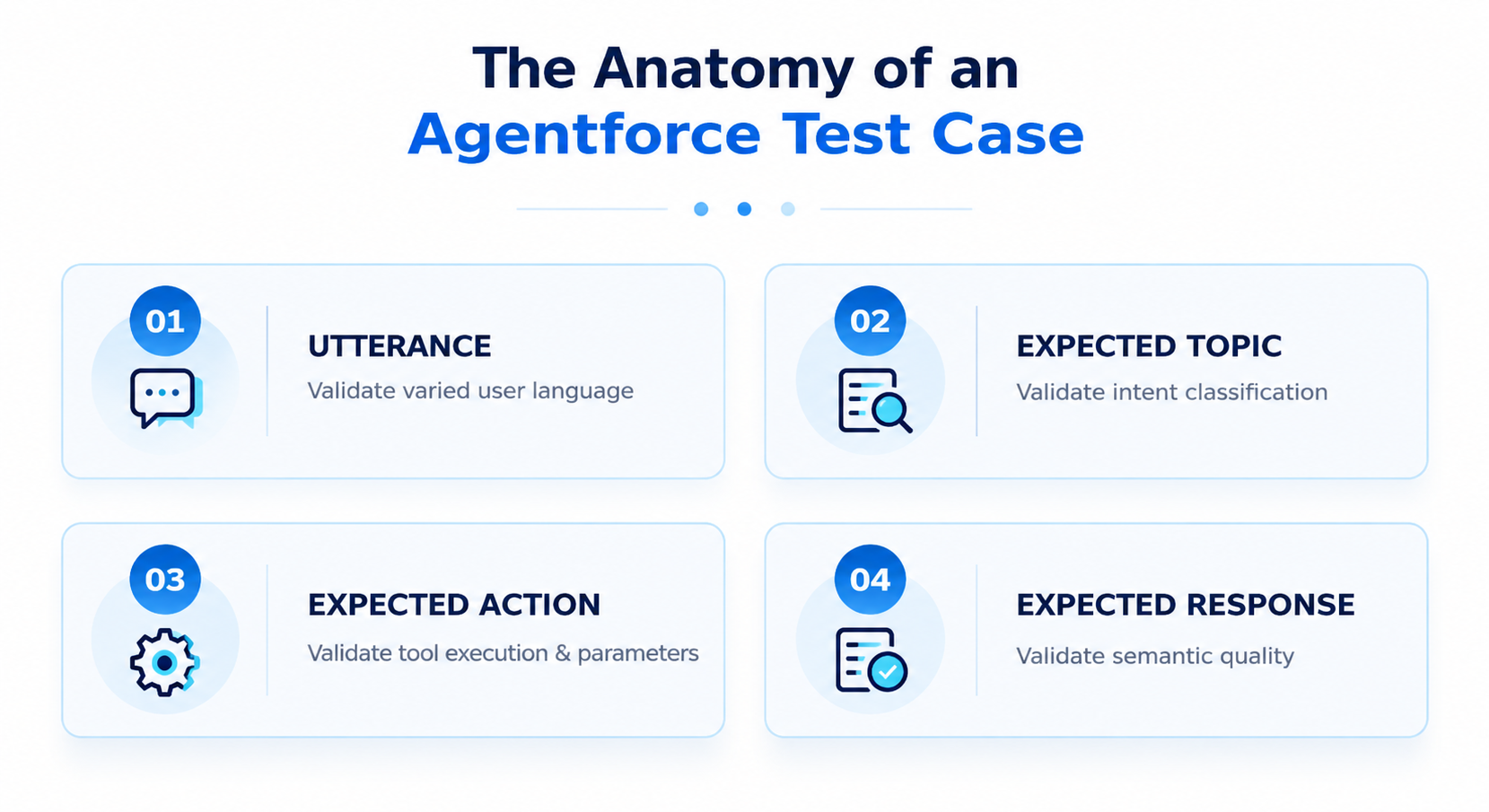
The utterance is the raw text prompt provided by the user. Because users are unpredictable, the test suite must include many variations of utterances for the same goal.
Before the agent acts, it must classify what the user wants. Agentforce uses Topics to group capabilities. QA must validate that the utterance triggered the correct Topic; otherwise, the agent may load the wrong instructions.
Example: “Push the Acme Corp deal to next quarter” should route to Opportunity_Management rather than Account_Support.
Once the topic is identified, the agent chooses a tool or action to execute, such as an Autolaunched Flow, Apex class, or prompt template. This is the most critical technical validation step.
Because LLMs generate text dynamically, strict string matching is not appropriate. QA should evaluate whether the response is concise, accurate, and semantically confirms the expected business result.
“Test the meaning of the response—not the exact sentence.”
Instead of asserting an exact response string, use LLM-as-a-judge evaluation to assess whether the response accurately confirms the stage or date change based on the Opportunity record retrieved in the Action step.
Abandon strict string matching. Rely on AI-driven scoring or semantic similarity checks; the exact phrasing can change while the business value remains constant.
Simulate complex chats. Test whether the agent correctly remembers an Account ID mentioned several messages earlier.
Inject vague utterances and verify that the agent asks a clarifying question rather than guessing the wrong Topic.
Use prompt-injection scenarios to test whether the agent can bypass policy or Salesforce security.
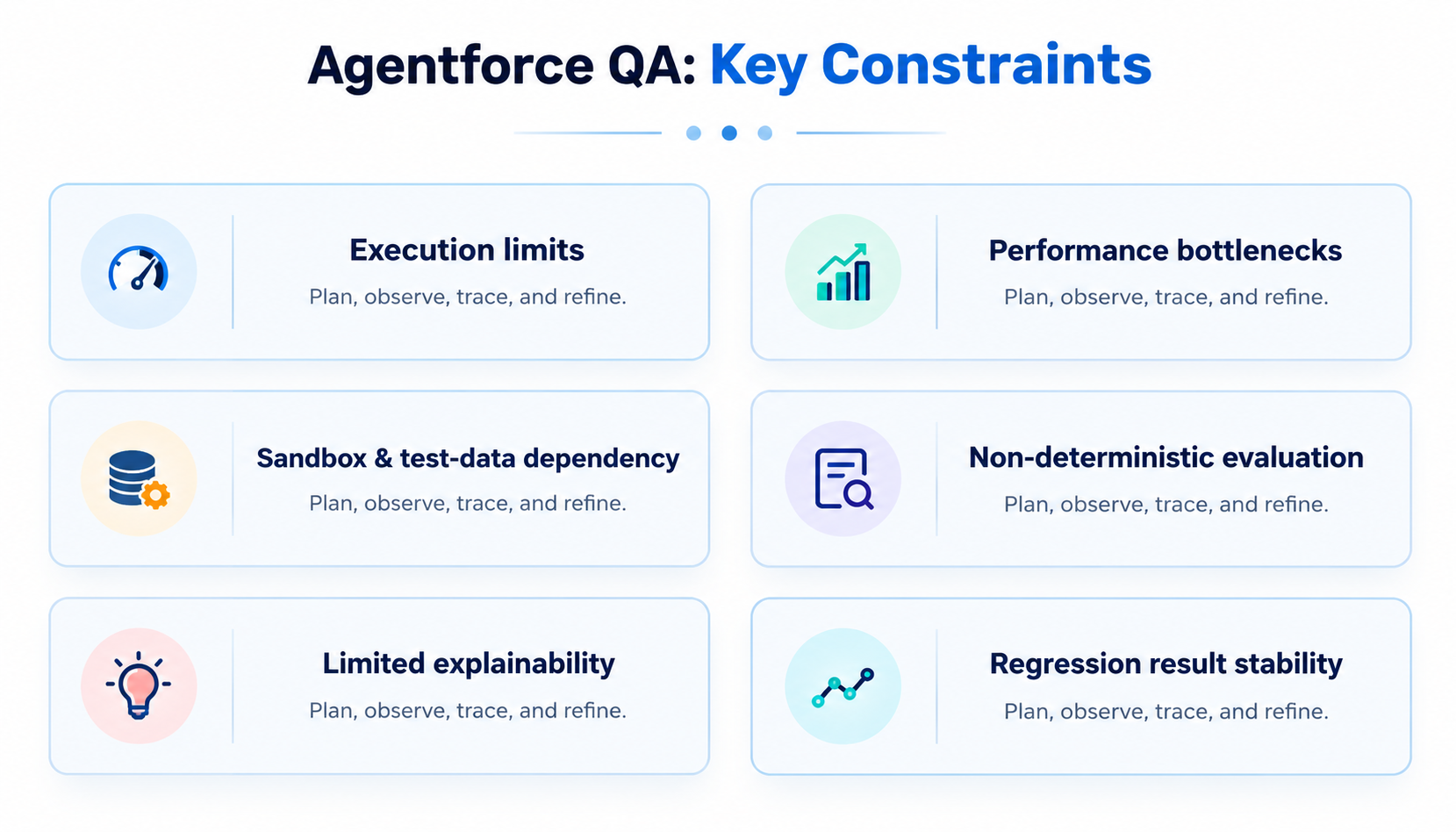
QA teams must orchestrate their tests around several native Salesforce limits and AI-specific constraints.
Deploying an AI agent without rigorous testing risks reputational damage and data leaks. By structuring QA around the rigorous evaluation of Utterances, Topics, Actions, and Responses, teams can turn unpredictable AI into a reliable enterprise asset.
“Turn unpredictable AI into a reliable enterprise asset.”
Level 3, Customs House, 31 Alfred St, Sydney, NSW 2000
Level 3, 162 Collins Street, Melbourne VIC 3000
Office 413-415, 4th Floor, Signature Tower, Lal Kothi Scheme, DC II, Tonk Road, Jaipur - 302015
Tower B, Office No - 1604, 16th Floor, Mont Claire Office Spaces by Mont Vert, Baner-Pashan Link Road, Pune - 411021
Level 3, Customs House, 31 Alfred St, Sydney, NSW 2000
Level 3, 162 Collins Street, Melbourne VIC 3000
Office 413-415, 4th Floor, Signature Tower, Lal Kothi Scheme, DC II, Tonk Road, Jaipur - 302015
Tower B, Office No - 1604, 16th Floor, Mont Claire Office Spaces by Mont Vert, Baner-Pashan Link Road, Pune - 411021