

CRM systems have long served to collect information about customers and manage sales. But when it comes to financial services, this is no longer enough.
Banks, investment firms, insurance companies, and lenders must respond to their customers' growing expectations, comply with regulations, and provide the most seamless and personalized experiences. People expect their financial advisors to know not just the basics — but their wants, needs, relationships, financial goals, liabilities, life events, and more.
This is where Salesforce Financial Services Cloud comes in. While many of Salesforce's products are verticals of its core offerings (e.g. Sales Cloud, Service Cloud), Financial Services Cloud is a standalone solution targeting specific finance industries. It is designed to serve the specific needs of financial institutions and help them manage complex client relationships with the help of relationship analytics, specialized data models, and industry-specific insights.

Salesforce Financial Services Cloud (FSC) is an industry-specific, cloud-based solution built on the Salesforce Platform that empowers financial institutions to engage their customers and manage both financial and industry-specific business processes from a single place.
Financial Services Cloud can be applied by banks, wealth management companies, insurers, lenders, mortgage originators, and other financial companies. Unlike other CRM systems, FSC caters to the specific needs of financial organizations — offering a specialized data model, industry-specific features, and a unified customer financial profile.
FSC Supports the Following Financial Domains:
A standard CRM system can help a salesperson manage relationships with customers and prospects. However, financial services companies need a more specialized solution to manage the wealth of information relating to their clients.
For example, when preparing for a meeting with a client, an advisor will need to examine the details of their family and assets, joint accounts, investments, home loans, insurance, retirement savings, requests for services, and previous interactions. This information is distributed across different software programs and systems — taking time to find, extract, and analyze.
The Financial Services Cloud helps to consolidate this information and provide an advisor with a comprehensive view of their customer's financial life — saving time on research and devoting more time to providing quality financial services and advice.


While traditional CRM is great for managing customer records, sales transactions, and service processes, it does not address the specific business processes and data relationships that are common in the financial services industry. Before FSC, every institution had to build custom objects, relationships, automations, and business logic from scratch — adding complexity and cost to every implementation.
While there are a variety of needs across different financial institutions, the fundamental needs tend to remain the same: financial accounts, customer management, households, financial goals, referrals, and interaction histories.
Salesforce built Financial Services Cloud to solve this by providing a standard financial services data model, critical business processes, and best practices ready to implement immediately. Because FSC is focused on a configuration-first approach, it reduces development costs while increasing implementation speed and flexibility.
Financial Services Cloud delivers true 360-degree customer views that enable financial institutions to connect with their clients through a holistic understanding of their relationships. It gives relationship managers a comprehensive view of all interactions and services associated with a particular customer or group — tracking financial objects, accounts, cases, and related services.

When it comes to financial services, relationships rarely involve a single person. Financial Services Cloud can store information about each family member, spouse, business partner, beneficiary, agent, trustee, or company. Relationship analytics give advisors valuable insights into their clients' behaviours and motivations while supporting more effective selling and service strategies.
Financial products and services are typically bought and managed by households. Financial Services Cloud helps relationship managers serve their clients better by providing them with a complete view of their customer households — the information associated with each member and their financial needs and goals.
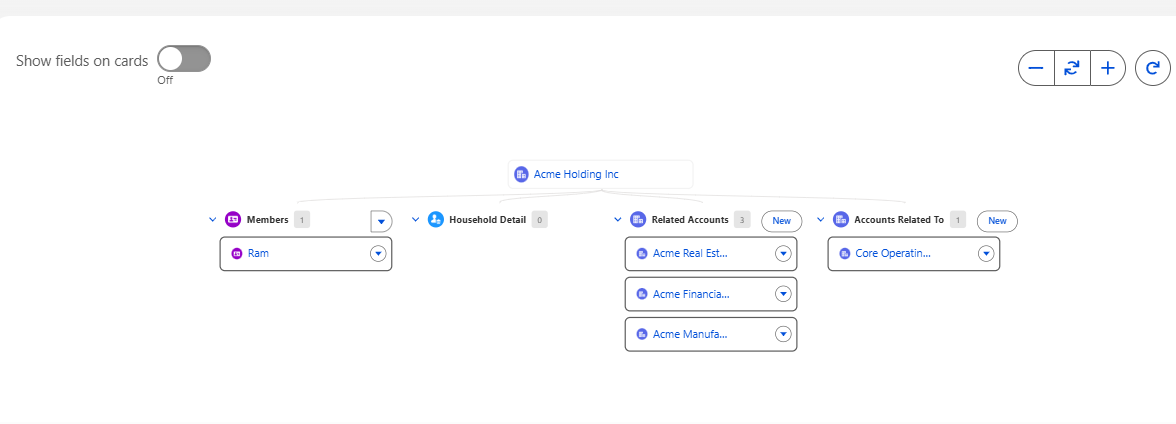
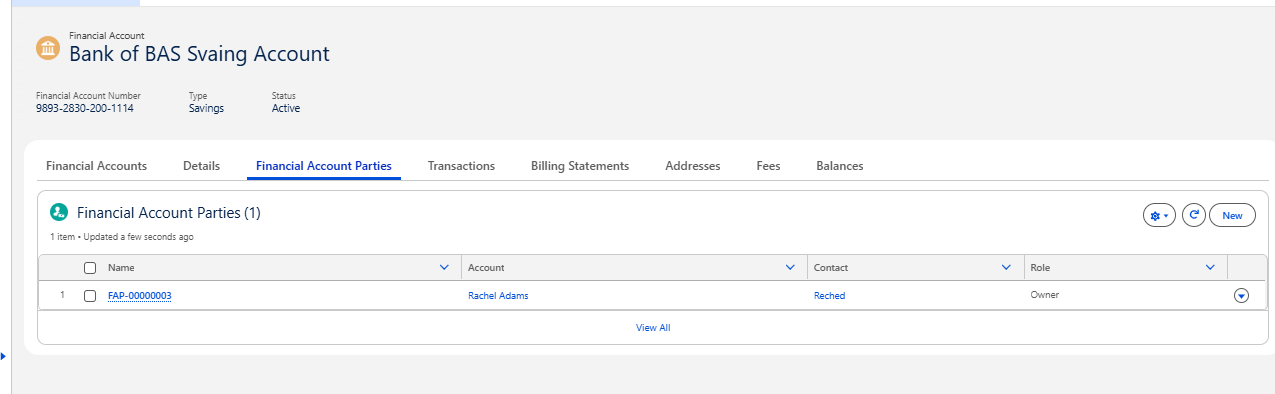
Unlike a standard CRM, Financial Services Cloud offers industry-specific data models including those related to financial accounts. FSC covers savings and checking accounts, credit cards, mortgages, investments, and insurance policies. This dramatically simplifies customization, accelerating digital transformation and reducing costs.
Customers typically use financial products and services to meet their personal goals, and financial institutions must do their utmost to understand them. FSC helps financial advisors learn about their clients' objectives — retirement planning, children's education, buying a home, and vacations — so they can offer appropriate products and services.

Salesforce Financial Services Cloud can help you transform your operations through process automation, driving higher levels of efficiency and customer satisfaction. You can design and deploy automations — from simple to complex — using Salesforce Flow and OmniStudio. Process automation reduces manual tasks and ensures consistent, compliant performance while shortening onboarding and service times.
Artificial intelligence is essential to Financial Services Cloud. Salesforce uses Einstein AI and Agentforce to empower financial institutions to drive advisor productivity, automate processes, deliver next-best-action guidance to customers and employees, and gain valuable insights to recommend products and services that meet their needs.
AI Can Benefit Financial Institutions By:
By harnessing the capabilities of Financial Services Cloud, financial institutions can reap a myriad of benefits:
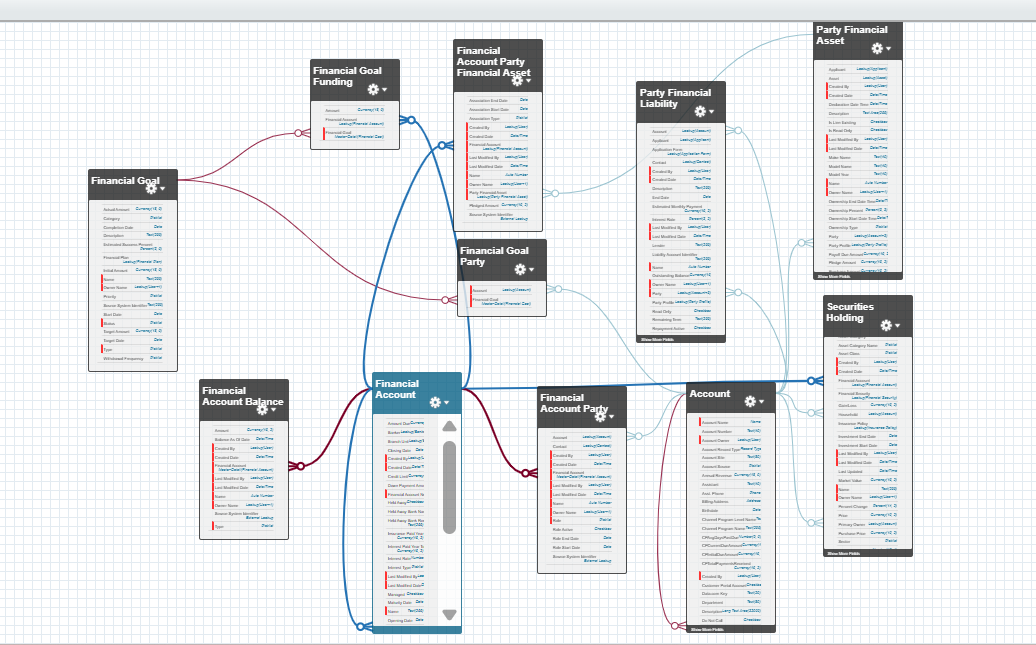
Unlike a generic CRM, Financial Services Cloud has a purpose-built core data model. It enables businesses to spend less time on building the foundation and more time delivering value to customers — providing pre-configured industry objects and relationships.
One of the main benefits of Financial Services Cloud is that it has many built-in (out-of-the-box) features and capabilities. These OOTB functions help financial institutions get results faster and avoid the need for costly custom development.
Support for checking, savings, mortgages, loans, credit cards, securities, insurance policies, and mutual funds as standard objects.
Tracks customer goals such as retirement, house purchases, education planning, and wealth building.
Defines and standardizes common financial services processes — client onboarding, new account opening, service requests, and more.
Create, assign, and track referral opportunities with referral originators across teams and channels.
Maintains a complete interaction history with the customer across every meeting, call, and digital touchpoint.
Tracks life milestones in a client's life so advisors can reach clients at the appropriate time.
Proactively notifies advisors of events requiring client follow-up — reducing missed opportunities.
Build client-facing digital journeys, dynamic forms, and custom automation with low-to-no-code functionality.
Aggregates total assets, liabilities, deposits, loans, and investment balances at a glance — without manual calculation.
Tracks key customer and business events so advisors can engage at exactly the right moment.
At the heart of Financial Services Cloud is a purpose-built data model for each major financial domain. Unlike a generic CRM, FSC ships pre-configured with the objects and relationships most critical to financial institutions.


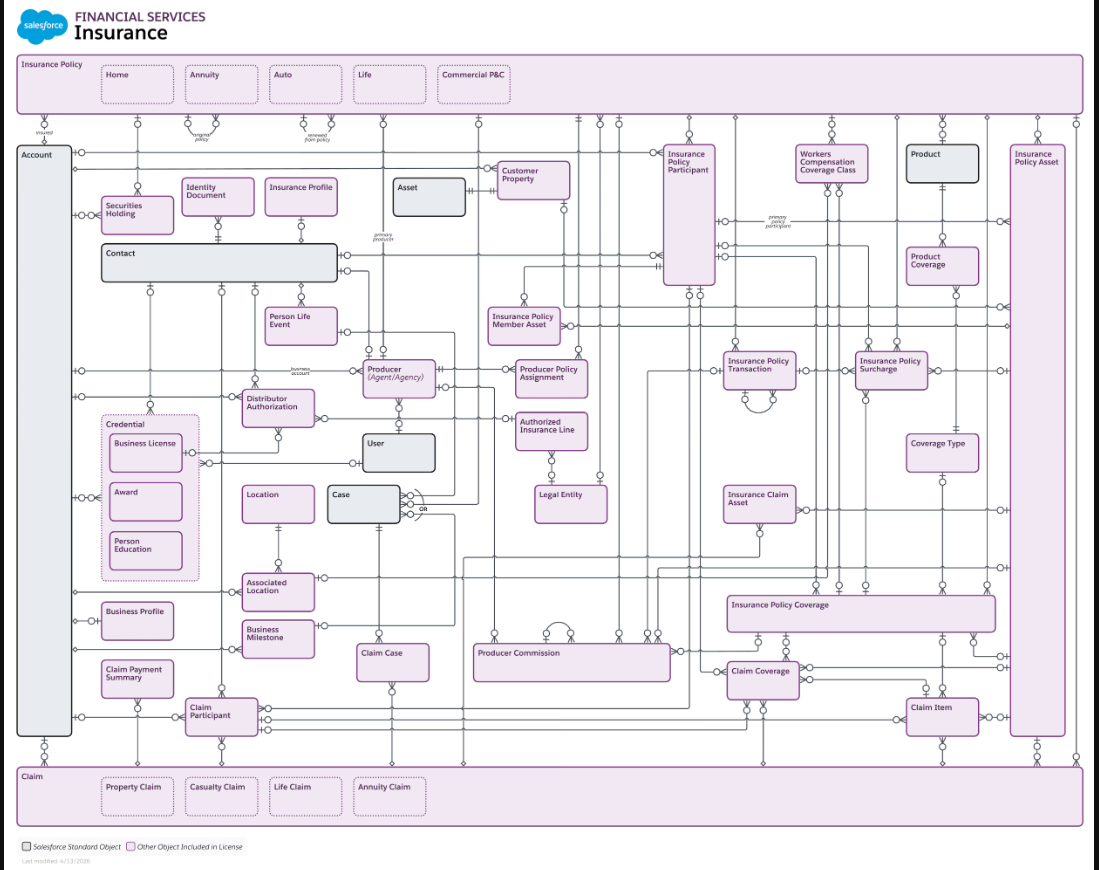


Financial Services Cloud is more than a traditional CRM for the financial industry. Its industry-specific data model is the foundation — but the real value is the entire ecosystem it provides: ready-to-use business capabilities, intelligent automation, AI-powered experiences, integrations, and industry best practices.
Rather than months of designing custom objects, relationships, and business processes, financial institutions can leverage a configuration-first platform that speeds implementation and lowers long-term maintenance. This allows organizations to concentrate on personalized customer experiences, advisor productivity, and business innovation.
As customer expectations change, Financial Services Cloud helps banks, insurers, lenders, and wealth management firms to develop trusted relationships, enhance operations, and deliver modern financial services at scale on the Salesforce Platform.
Rather than months of designing custom objects and relationships, financial institutions can leverage a configuration-first platform that speeds implementation and lowers maintenance over the long term.
Level 3, Customs House, 31 Alfred St, Sydney, NSW 2000
Level 3, 162 Collins Street, Melbourne VIC 3000
Office 413-415, 4th Floor, Signature Tower, Lal Kothi Scheme, DC II, Tonk Road, Jaipur - 302015
Tower B, Office No - 1604, 16th Floor, Mont Claire Office Spaces by Mont Vert, Baner-Pashan Link Road, Pune - 411021
Level 3, Customs House, 31 Alfred St, Sydney, NSW 2000
Level 3, 162 Collins Street, Melbourne VIC 3000
Office 413-415, 4th Floor, Signature Tower, Lal Kothi Scheme, DC II, Tonk Road, Jaipur - 302015
Tower B, Office No - 1604, 16th Floor, Mont Claire Office Spaces by Mont Vert, Baner-Pashan Link Road, Pune - 411021